Card Games in Public Rooms: The Social Life Around the Table
Card games in public rooms could be one part of a gathering. Learn how to describe a venue’s use from the evidence without assuming its purpose or stakes.
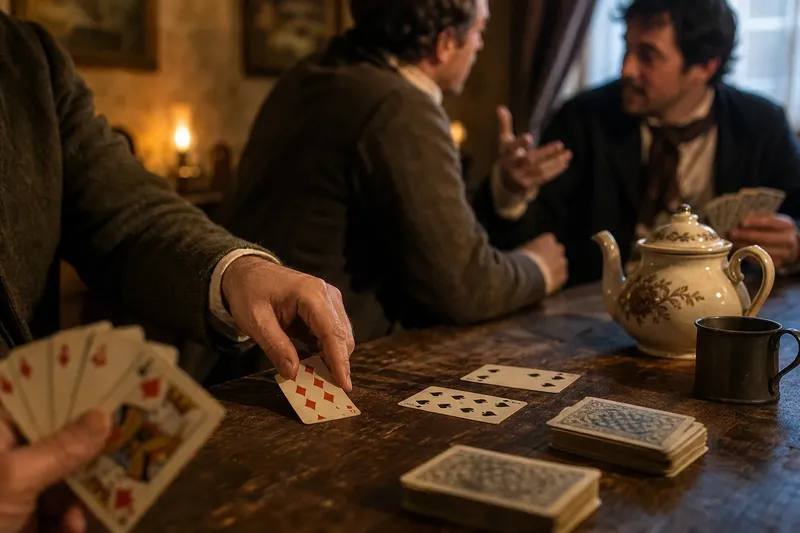
A deck lies beside a teapot in an inn’s upstairs room. One person deals; another pauses to speak with a neighbour. The scene offers a useful starting point for thinking about card games in public rooms, but a historical account of any particular room needs evidence tied to its place and period.
“Public room” is a broad description, not a single historical category. It may refer to an inn room, a club space or a hired assembly room, depending on the source. The words alone do not establish who could enter, what activities took place or whether anyone wagered.
What did “public room” mean for card players?
A public room was a shared space beyond a private household, but access could still be limited by membership, invitation, custom or control of the venue. The term does not mean that everyone had equal access.
Cards are portable, so people could play in a room used for other purposes. An account might describe cards alongside supper, conversation or a meeting; another might present gaming as the main reason for gathering. Those descriptions should come from evidence about the particular occasion, rather than from a general assumption about inns or clubs.
How could the room shape the game?
The setting can help explain how an occasion was organised. A group might arrive together, join a game already under way or play according to customs they had agreed among themselves. If a source describes staff or venue rules shaping play, that role belongs in the account too.
A table is a little like a kitchen table cleared after supper: it makes a game possible, but does not by itself tell us why the people gathered. The room’s furniture is a clue, not a full description of its social purpose.
How can a source distinguish a social room from a gaming venue?
Use concrete details to choose the narrowest description the evidence supports. Each clue can guide a decision, while an unanswered point should remain open.
- Other activities: If the account mentions meals, meetings or music alongside cards, describe that occasion as multi-use; if it presents gaming as the main draw, describe it as gaming-centred.
- Admission: If access depended on membership or invitation, state that boundary; if organised public entry is described, do not call the room a private club on that evidence alone.
- Who arranged play: If players set their own customs, describe the game as group-organised; if staff or venue rules set conditions, include the establishment’s role.
- How the visit is described: If cards appear as one part of a visit, avoid calling the whole occasion a gaming outing; if people came chiefly to play, say the game appears central to that occasion.
- What the room was for: If the source names an inn parlour or assembly room, retain that specific label; if it identifies a gaming establishment, do not flatten it into a generic public room.
- What is left unsaid: If money is not mentioned, do not infer stakes; if access or other activities are omitted, mark those details as unknown.
What does a careful reading look like?
Say an invented diary entry records four visitors meeting in an inn parlour after supper. It says they played cards, then left before the room was arranged for a later gathering. The starting details are four visitors, an inn parlour, supper, cards and another use of the room.
Describe the occasion as a social visit that included card play, and the room as one used for more than one purpose. The entry does not state whether money changed hands, so the decision is to leave wagering unspecified. It also does not explain how the visitors gained access, so that remains unknown rather than assumed.
What do readers ask about card games in public rooms?
Were public card rooms the same as casinos?
No. A public room might host several kinds of gathering, while a casino is organised around gaming. For a historical venue, use the source’s account of its purpose and activities rather than the presence of cards alone.
Why might people play cards in an inn or club?
A shared venue provided a place to gather, and cards could be played without elaborate equipment. Whether the game was a side activity or the main event depends on the account of that particular occasion.
Does a record of card play show that money was involved?
No. A reference to cards does not establish whether people wagered, played for amusement or followed another arrangement. Include stakes only when the source states them.
Did specialised gaming venues replace social card play?
Do not assume a single pattern across places and periods. A gaming-centred venue and a multi-use social room could serve different purposes, and evidence about one does not establish what happened to the other.
Why does the setting still matter?
Setting helps an account distinguish a room’s documented use from a guess about its purpose. When a source says only that people played cards in a shared room, describe that activity plainly and leave access, stakes and the rest of the evening unresolved unless further evidence addresses them.